I wanted to write a Good Friday post and decided that it would be wise to refer to the saints for material for meditation. I found a wonderful book called The Passion and the Death of Jesus Christ1 by St. Alphonsus Liguori.2 After reading a little of the book, I decided that the saint’s words are far more suitable than mine would be.
Accordingly, the majority of this post is a series of excerpts from said book. I have selected meditations that correspond to the five Sorrowful Mysteries of the Holy Rosary: the Agony in the Garden, the Scourging at the Pillar, the Crowning with Thorns, the Carrying over the Cross, and the Crucifixion. Of these meditations, I focused on passages that speak of Jesus’s love for us.
For his Sorrowful Passion is the supreme token of his love for us and most worthy of our meditation. “God commendeth his charity towards us; because when as yet we were sinners, according to the time, Christ died for us.”3 Let us, therefore, mindful of our Redeemer’s blood that has been spilt so violently for our sakes, lament and grieve over our many sins and turn again to that most holy font of life.
The Agony in the garden
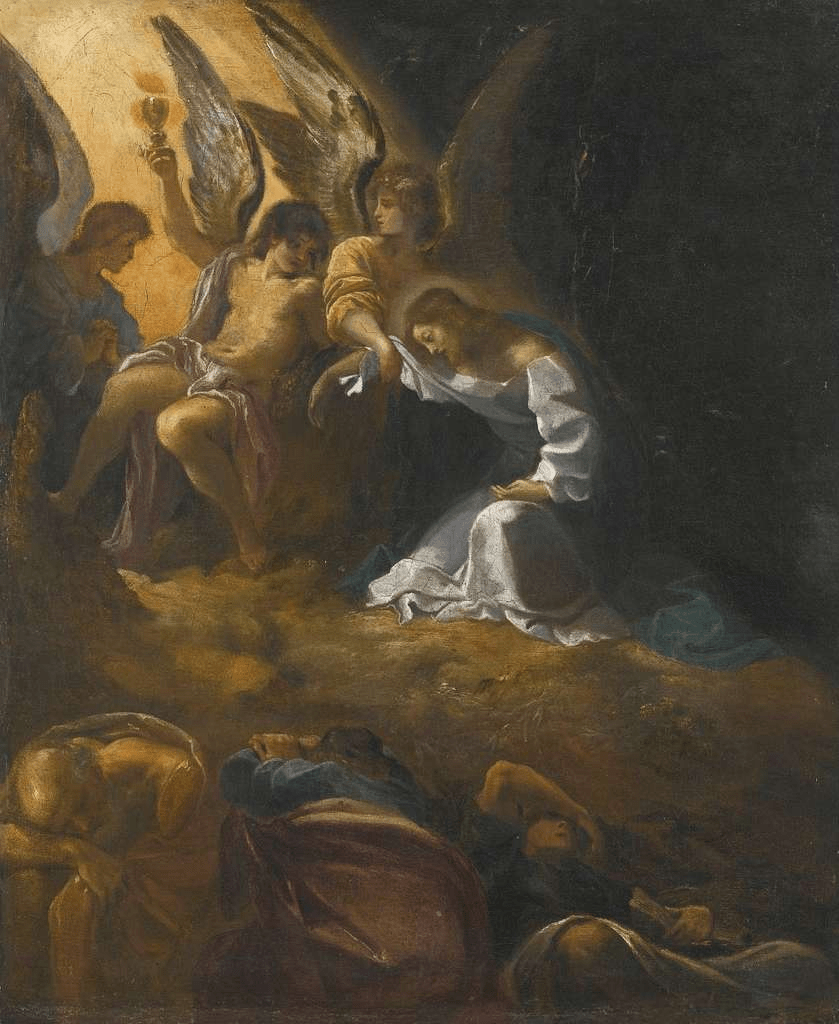
The first sorrowful mystery is the Agony in the Garden.
Then Jesus came with them into a country place which is called Gethsemane; and he said to his disciples: Sit you here, till I go yonder and pray. And taking with him Peter and the two sons of Zebedee, he began to grow sorrowful and to be sad. Then he saith to them: My soul is sorrowful even unto death: stay you here and watch with me. And going a little farther, he fell upon his face, praying, and saying: My Father, if it be possible, let this chalice pass from me. Nevertheless, not as I will, but as thou wilt.4
“Jesus […] goes to the Garden of Gethsemani, whither he knew already that his enemies would come to take him. He there betakes himself to prayer, and lo! he finds himself assailed by a great dread, by a great repugnance, and by a great sadness. […] There came upon him, first, a great dread of the bitter death which he would have to suffer on Calvary, and of all the anguish and desolations by which it would be accompanied. During the actual course of his Passion, the scourges, the thorns, the nails, and the rest of his tortures came upon him but one at a time; whereas, in the garden, they all came upon him together at once, crowding into his memory in order to torment him. For this love of us he embraced them all; but in embracing them, he trembles and is in agony: Being in agony, He prayed the longer.
“There comes upon him, moreover, a great repugnance to that which he has to suffer; so that he prays his Father to deliver him from it […] He prayed thus to teach us that in our tribulations we may indeed beg of God to deliver us from them; but we ought at the same time to refer ourselves to his will, and to say, as Jesus then said, Not, however, as I will, but as thou wilt. Yes, my Jesus, Thy will, not mine, be done. I embrace all the crosses that Thou wilt send me. Thou, innocent as Thou art, hast suffered so much for love of me; it is but just that I, who am a sinner, and deserving of hell, should suffer for love of Thee that which Thou dost ordain.
“There came upon him, likewise, a sadness so great that it would have been enough to cause him to die, had he not, of himself, kept death away, in order to die for us after having suffered more. […] This great sadness was occasioned by the sight of the future ungratefulness of men, who, instead of corresponding to so great a love on his part, would offend him by so many sins, the sight of which caused caused him to sweat in streams of blood. […]
“So then, O my Jesus, it is not the executioners, the scourges, the thorns, or the cross that have been so cruel: the cruelty lies in my sins, which afflicted Thee so much in the garden. Do Thou give me, then, a share of that sorrow and abhorrence which Thou didst experience in the garden, that so, even to my death, I may bitterly weep for the offences that I have given Thee. I love Thee, O my Jesus: do Thou receive with kindness a sinner who wishes to love Thee. Recommend me, O Mary, to this thy Son, who is in affliction and sadness for love of me.”5
The scourging at the pillar
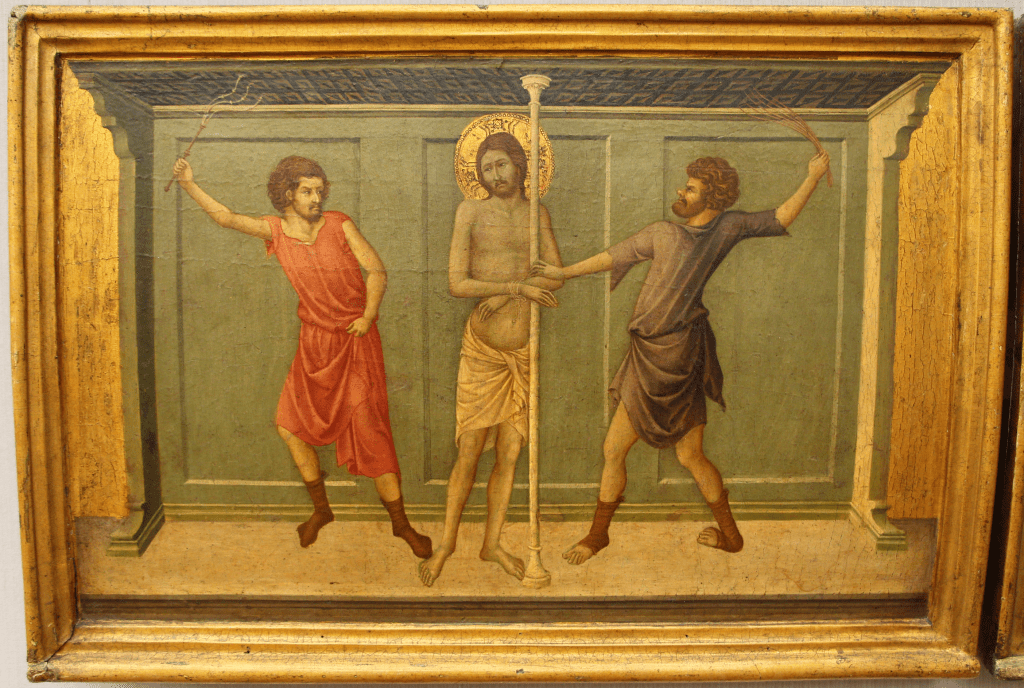
The second sorrowful mystery is the Scourging at the Pillar.
Then therefore, Pilate took Jesus, and scourged him.6
“Behold how they now lay hold of the scourges, and, at a given sign, begin to strike, in every part, that sacred flesh, which at first assumes a livid appearance, and then is covered all over with blood, that flows from every pore. Alas, the scourges and the executioners’ hands are all now dyed in blood; and with blood is the ground all drenched. But, O God, through the violence of the blows, not only does the blood, but pieces of the very flesh, of Jesus Christ go flying through the air. That divine body is already but one mass of wounds; and yet do those barbarians continue to add blow to blow and pain to pain. And all this while, what is Jesus doing? He speaks not; he complains not; but patiently endures that great torture in order to appease the divine justice, that was wroth against us. […] Go quickly, O my soul, go and wash thyself in that divine blood.
“My beloved Savior, I behold Thee all torn in pieces for me; no longer, therefore, can I doubt that Thou dost love me, and love me greatly, too. Every wound of Thine is a sure token on Thy part of Thy love, which with too much reason demands my love. Thou, O my Jesus, dost, without reserve, give me Thy blood; it is but just that I, without reserve, should give Thee all my heart. Do Thou, then, accept of it, and make it to be ever faithful.
“O my God, had Jesus Christ not suffered more than a single blow for love of me, I ought yet to have been so burning with love for him, saying, A God hath been willing to be struck for me! But no: he contented not himself with a single blow; but, to pay the penalty due to my sins, he was willing to have his whole body torn to shreds […] While, then, O my soul, Jesus was being scourged, he was thinking of thee, and offering to God those bitter sufferings of his, in order to deliver thee from the eternal scourges of hell. O God of love, how have I been able to live so many years, in time past, without loving Thee? O ye wounds of Jesus, wound me with love towards a God who has loved me so much! O Mary, O Mother of graces, do thou gain for me this love!”7
The Crowning with thorns
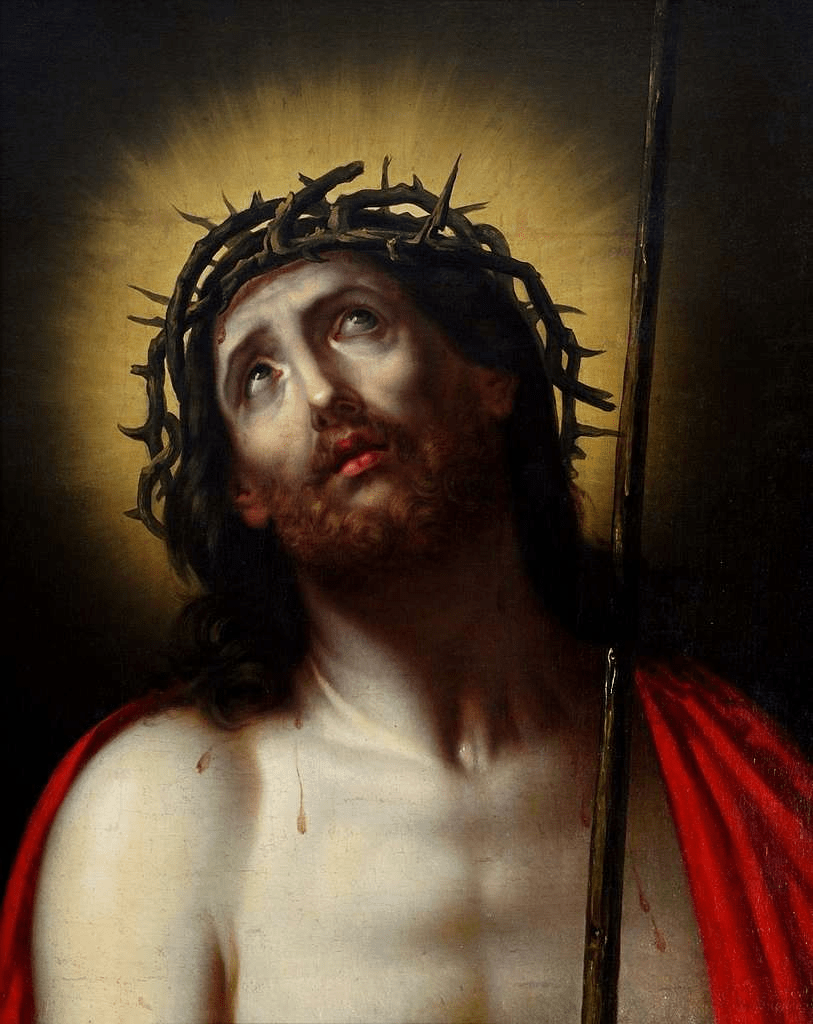
The third sorrowful mystery is the Crowning with Thorns.
Then the soldiers of the governor taking Jesus into the hall, gathered together unto him the whole band; and stripping him, they put a scarlet cloak about him. And platting a crown of thorns, they put it upon his head, and reed in his right hand. And bowing the knee before him, they mocked him, saying, Hail, king of the Jews. And spitting upon him, they took the reed, and struck his head.8
“O my God! how the blood is now streaming down from that pierced head over the face and the breast of Jesus!
“And Thou, my Savior, dost not even utter a complaint of such unjust cruelties! Thou art the King of heaven and of earth; but now, my Jesus, Thou art brought down so low as to appear before us a king of derision and of sorrows, being made the laughing-stock of all Jerusalem. But the prophecy of Jeremias had to be fulfilled, that Thou wouldst one day have Thy fill of sorrows and shame […] O Jesus, my love! in time past I have despised Thee; but now I prize Thee, and I love Thee with all my heart, and I desire to die for love of Thee.
“[…] Do thou at least go, O my soul, and recognize Jesus for what he is, the King of kings, and Lord of lords; and returns thanks to him, and love him, now that thou beholdest him become, for love of Thee, the king of sorrows. O my Lord, keep not in Thy remembrance the griefs which I have caused Thee. I now love Thee more than myself. Thou only dost deserve all my love, and, therefore, Thee only do I wish to love. I fear, on account of my weaknesses; but it is for Thee to give me the strength to execute my desire. And thou, too, O Mary, must help me by thy prayers.”9
the carrying of the cross
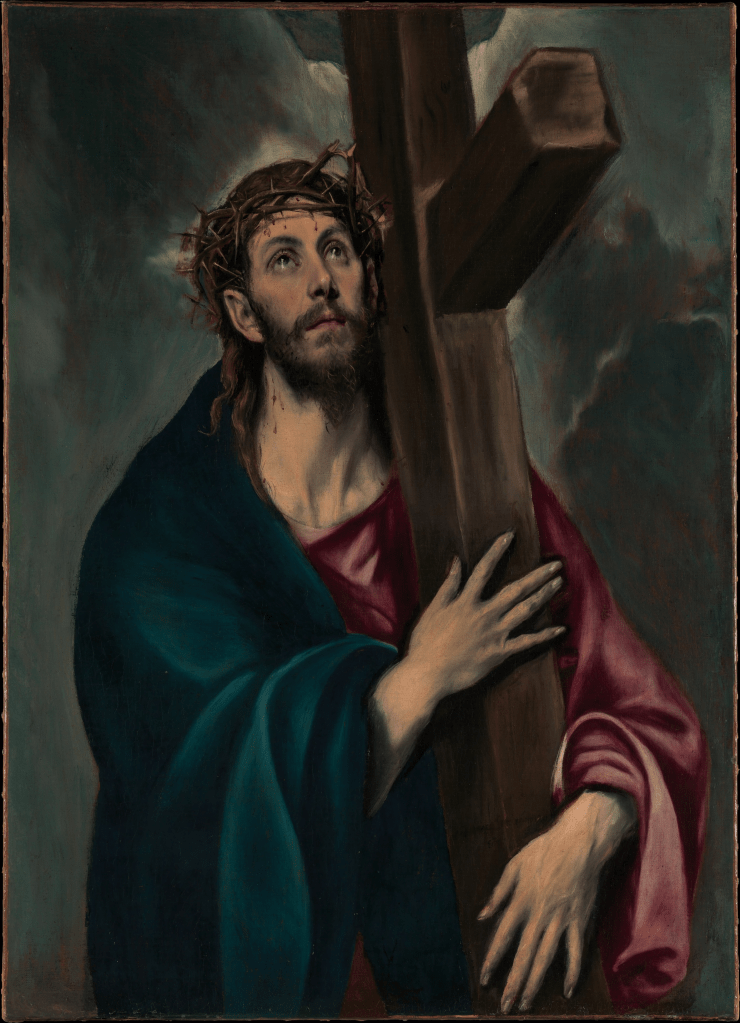
And after they had mocked him, they took off the cloak from him, and put on him his own garments, and led him away to crucify him.10
“Jesus refuses not the cross; with love he embraces it, as being the altar whereon is destined to be completed the sacrifice of his life for the salvation of men […] The condemned criminals now come forth from Pilate’s residence, and in the midst of them there goes also our condemned Lord. O that sight, which filled both heaven and earth with amazement! To see the Son of God going to die for the sake of those very men from whose hands he is receiving his death! […]
“O my Redeemer! by the merits of this sorrowful journey of Thine, give me strength to bear my cross with patience. I accept of all the sufferings and contempts which Thou dost destine for me to undergo. Thou has rendered them lovely and sweet by embracing them for love of us: give me strength to endure them with calmness.
“Behold, my soul, now that thy condemned Savior is passing, behold how he moves along, dripping with blood that keeps flowing from his still fresh wounds, crowned with thorns, and laden with the cross. Alas, how at every motion is the pain of all his wounds renewed! The cross, from the first moment, begins its torture, pressing heavily upon the thorns of the crown. O God! at every step, how great are the sufferings! Let us meditate upon the sentiments of love wherewith Jesus, in his journey, is drawing nigh to Calvary, where death stands awaiting him.
“Ah, my Jesus, Thou art going to die for us. In time past I have turned my back upon Thee, and would that I could die of grief on this account! but for the future I have not heart any more to leave Thee, O my Redeemer, my God, my love, my all! O Mary, my Mother, do thou obtain for me strength to bear my cross in peace.”11
the crucifixion
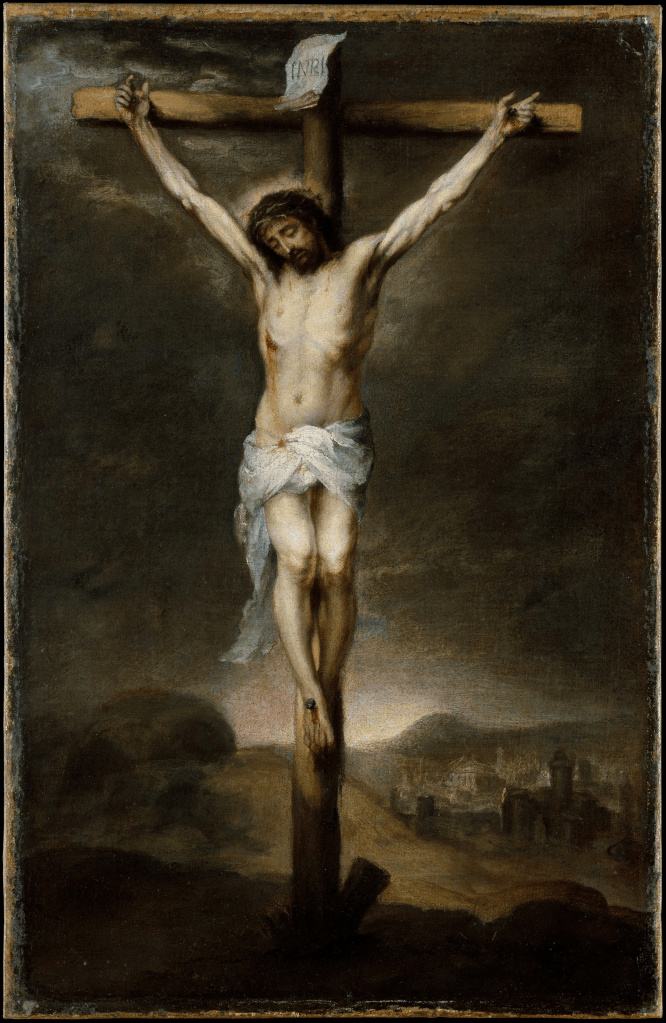
“Jesus on the cross! Behold the proof of the love of God; behold the final manifestation of himself, which the Word Incarnate makes upon this earth,–a manifestation of suffering indeed, but, still more, a manifestation of love. St. Francis of Paola, as he was one day meditating upon the divine Love in the person of Jesus Crucified, rapt in ecstasy, exclaimed aloud three times, in these words, ‘O God – Love! O God – Love! O God – Love!’ wishing hereby to signify that we shall never be able to comprehend how great has been the divine love towards us, in willing to die for love of us.
“O my beloved Jesus! if I behold Thy body upon this cross, nothing do I see but wounds and blood; and then, if I turn my attention to Thy heart, I find it to be all afflicted and in sorrow. Upon this cross I see it written that Thou art a king; but what tokens of majesty dost Thou retain? I see not any royal throne save that of this tree of infamy; no other purple do I behold save Thy wounded and bloody flesh; no other crown save this band of thorns that tortures Thee. Ah, how it all declares Thee to be king of love! yes, for this cross, these nails, this crown, and these wounds are, all of them, tokens of love.”12
“Ah, my Jesus, and who is there that will not love Thee, while confessing Thee to be the God that Thou art, and contemplating Thee upon the cross? Oh, what arrows of fire dost Thou not dart at souls from that throne of love! Oh, how many hearts hast Thou not drawn to Thyself from that cross of Thine! O wounds of my Jesus! O beautiful furnaces of love! admit me, too, amongst yourselves to burn […] with holy flames of love for that God who has been willing to die for me, consumed by torments. O my dear Redeemer! receive back a sinner, who, sorrowing for having offended Thee, is now earnestly longing to love Thee. I love, I love Thee, O infinite goodness, O infinite love. O Mary, O Mother of beautiful love! obtain for me a greater measure of love, to consume me for that God who has died consumed of love for me.”13
“He is dead! O God! who is it that is dead? The author of life, the only-begotten Son of God, the Lord of the world, – he is dead. O death! thou wert the amazement of heaven and of all nature. O infinite love! A God to sacrifice his blood and his life! And for whom? For his ungrateful creature; dying in an ocean of sufferings and shame, in order to pay the penalty due to their sins. Ah, infinite goodness! O infinite love!
“O my Jesus! Thou art, then, dead, on account of the love which Thou has borne me! Oh, let me never again live, even for a single moment, without loving Thee! I love Thee, my chief and only good: I love Thee, my Jesus, – dead for me! O my sorrowing Mother Mary! do thou help a servant of thine, who desires to love Jesus.
“Raise up thine eyes, my soul, and behold that crucified man. Behold the divine Lamb now sacrificed upon that altar of pain. Consider that he is the beloved Son of the Eternal Father; and consider that he is dead for the love that he has borne thee. See how he holds his arms stretched out to embrace thee; his head bent down to give the kiss of peace; his side open to receive thee into his heart. What does thou say? Does not a God so loving deserve to be loved? Listen to the words he addressed to thee from that cross: ‘Look, my son, and see whether there be any one in the world who has loved thee more than I have.'”14
“O God! had the vilest one of mankind suffered for me what Jesus Christ has suffered, could I ever refrain from loving him? Were I to see any man torn to pieces with scourges and fastened to a cross in order to save my life, could I ever bear it in mind without feeling a tender emotion of love? […]
“Ah, my Redeemer, O love of my soul! How shall I ever again be able to forget Thee? How shall I ever be able to think that my sins have reduced Thee so low, and not always bewail the wrongs that I have done to Thy goodness? How shall I ever be able to see Thee dead of pain on this cross for love of me, and not love Thee to the uttermost of my power?
“O my dear Redeemer! well do I recognize in these Thy wounds, and in Thy lacerated body […] the tender affection which Thou dost retain for me. Since, then, in order to pardon me, Thou hast not pardoned Thyself, oh, look upon me now with the same love wherewith Thou didst one day look upon me from the cross, whilst Thou wert dying for me. Look upon me and enlighten me, and draw my whole heart to Thyself, that so, from this day forth, I may love none else but Thee. Let me never be unmindful of Thy death. Thou didst promise that, when raised up upon the cross, Thou wouldst draw all our hearts to Thee. Behold this heart of mine, which, made tender by Thy death, and enamored of Thee, desires to offer no further resistance to Thy calls. Oh, do Thou draw it to Thyself, and make it all Thine own! Thou hast died for me, and I desire to die for Thee; and if I continue to live, I will live for Thee alone […] I love Thee, O infinite goodness; I love Thee, O infinite love. Thou art, and shalt ever be, my one and only love. O Mary, Mother of love, do thou obtain me love.”15
- A copy may be obtained here: https://www.saintsbooks.net/books/St.%20Alphonsus%20Maria%20de%20Liguori%20-%20The%20Passion%20and%20the%20Death%20of%20Jesus%20Christ.pdf ↩︎
- (Short biography): Castle, Harold, “St. Alphonsus Liguori.” The Catholic Encyclopedia, Vol. 1. (New York: Robert Appleton Company, 1907). https://www.newadvent.org/cathen/01334a.htm ↩︎
- Romans 5:8-9a (Douay-Rheims version) ↩︎
- Matthew 26:36-39 ↩︎
- Liguori, Alphonsus, The Passion and the Death of Jesus Christ, trans. Eugene Grimm (Elias Frederick Schauer, 1886), 431-432 ↩︎
- John 19:1 ↩︎
- Liguori, The Passion and the Death of Jesus Christ, 437-439 ↩︎
- Matthew 27:27-29 ↩︎
- Liguori, The Passion and the Death of Jesus Christ, 440-441 ↩︎
- Matthew 27:31 ↩︎
- Liguori, The Passion and the Death of Jesus Christ, 445-447 ↩︎
- Liguori, The Passion and the Death of Jesus Christ, 449-450 ↩︎
- Liguori, The Passion and the Death of Jesus Christ, 450 ↩︎
- Liguori, The Passion and the Death of Jesus Christ, 454-455 ↩︎
- Liguori, The Passion and the Death of Jesus Christ, 456 ↩︎
 Faith and Reason

